PLANNING GUIDES
What to do when the power goes down at work: A 5-step business survival plan
Updated 07/26
By: Content Team
Reviewed: Kim Staples
Electricity is one of the many things that is taken for granted in the modern era, yet power outages can occur at any time - usually at the worse time possible.
What to do in the first few minutes of a power cut at work
How to tell if it's your building or a wider network fault
Who to call for live updates on local power cuts
How to keep customers and staff informed during an outage
Whether backup power is worth it for your business
When to call an electrician for help
A power cut can strike at any time, and when it hits during business hours, it can bring tills, servers, phone lines, and security systems to a standstill.
Knowing exactly what to do in the first few minutes makes the difference between a minor inconvenience and a costly disruption.
In this short guide, we will provide you with a brief run down of the 5 steps you should take if and when the power goes down at work.
Find qualified electricians working in your area
1. Turn off all computers and sensitive appliances
As soon as you notice the power has gone, switch off computers, monitors, and any other sensitive electrical equipment at the socket. Leave one light switched on so you know the moment power returns.
This is important because when electricity supply is restored, it can arrive as a brief power surge. Equipment left switched on risks damage from that surge, whereas anything powered down safely rides it out.
If your business relies on a server or till system, an uninterruptible power supply (UPS) can give you a safe window to shut things down properly instead of losing data to a sudden cut.

2. Check whether it's just your building
If you can, check the other local offices in the building or other nearby buildings to see if their power has gone too.
If everywhere nearby is also without power, you're likely dealing with a wider network outage rather than a fault specific to your premises.
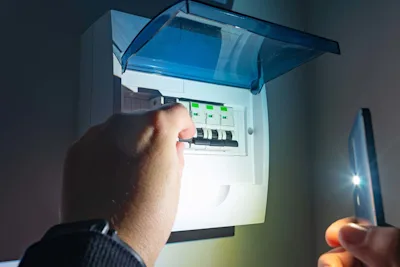
If the buildings next door still have power, the problem is probably with your own building's wiring, fuse board, or an appliance fault. That's a job for a qualified electrician, not something to wait out.
Find qualified electricians working in your area
3. Call 105 for network updates
The next thing you can do is call 105 to put you through to your local electricity network operator.
105 is a free service available to anyone in England, Scotland, and Wales, and can be used to find out information relating to power cuts in the local area - and when the power will be back up and running, of course.
Our guide to who to call in a power cut covers this in more detail, including what to do if the cut turns out to be a fault inside your own property rather than the network.
4. Keep staff and customers in the loop
Letting others know that you are in the middle of a power outage is a wise idea.
A quick social media update or a message to your team means customers aren't left guessing whether you're open, and staff know what's expected of them while the power is out.
If your business has a phone signal but no landline or Wi-Fi, a personal mobile hotspot can keep essential communications running until power is restored.
5. Make sure you have backup power
In the event of a blackout or power outage, it’s wise to have the option of a backup power source to help you resume normal service.
Your backup generator should be set up to start automatically, should the power ever go down. This will help to minimise your company losses as your generator will kick seamlessly into action and prevent any downtime.
For most small businesses, the priority systems worth protecting may be:
Till and payment systems
Security and alarm systems
Fridges and freezers holding stock
Servers and phone systems
When to call an electrician
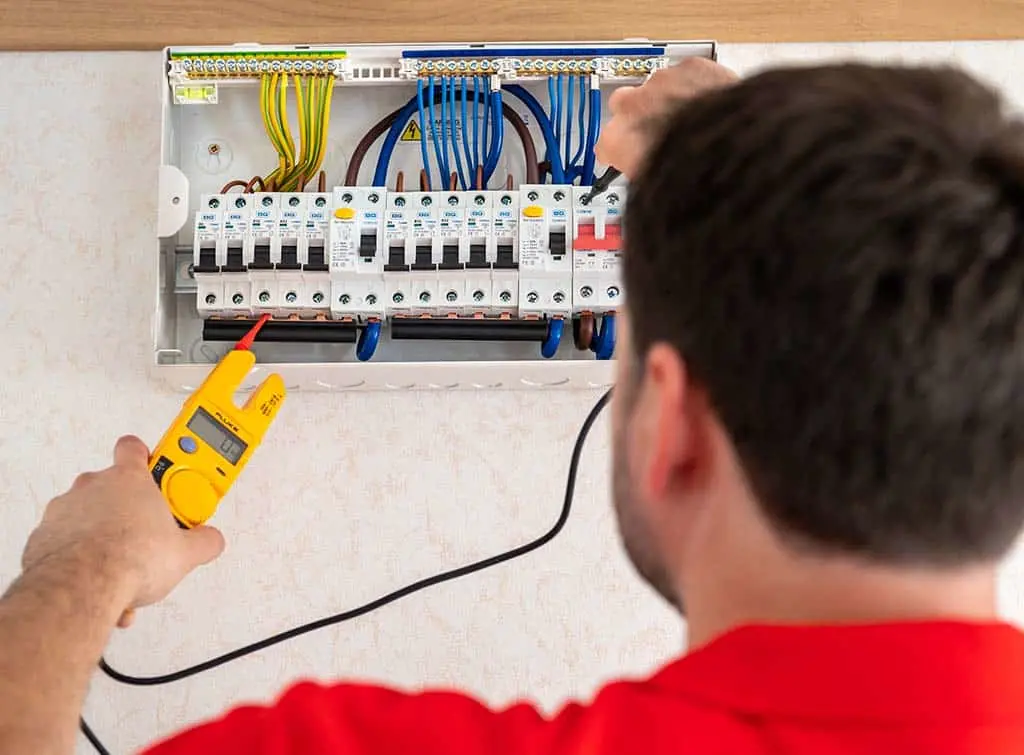
If your power outage appears to be limited to just your business rather than a network power cut, call an electrician in to get it fixed.
They'll be able to assess what the issue is and help you get it fixed.
Get started finding an electrician by searching your postcode on Checkatrade - you can browse electricians covering your area and get in touch straight away.
Find qualified electricians working in your area

Preparing your business for the next power cut
Power cuts are one of the few disruptions you genuinely can plan for.
Print out these five steps for the staff kitchen or break room, and make sure whoever's on shift knows where the fuse board is and how to reach an electrician if needed.
If your premises are prone to nuisance trips or you suspect the wiring itself might be the problem (rather than a network-wide cut), it's worth getting a commercial electrician to take a look.
An electrical safety check can also flag issues with your consumer unit before they cause repeat outages.
Power cut at work checklist
Keep this checklist handy when there's a power cut at your business.

Your power cut at work checklist

FAQs
Most local power cuts are resolved within a few hours, though this varies depending on the cause. Calling 105 will give you the most accurate estimate for your specific area and outage.
Yes. 105 is a free service available across England, Scotland, and Wales, funded by the electricity network operators.
It's a good idea to switch off sensitive equipment like computers and servers. A power surge when the electrical supply returns can damage anything left switched on.
Leaving one light on is a simple (and safe) way to know when power is restored.
If neighbouring buildings still have power, the fault is likely within your own property's wiring, fuse board, or an appliance, rather than a network-wide issue. This is worth getting checked by a qualified electrician.
If a power outage would be disruptive, then yes, it's worth seriously considering. Businesses that rely on refrigeration, servers, or security systems often find a properly sized backup generator pays for itself the first time it's needed. An electrician can advise on sizing for your premises.
A power cut is a loss of electricity supply. A power surge is a brief spike in voltage, often occurring when supply is restored after a cut, which can damage equipment left switched on.
Yes. If your fuse board or consumer unit trips frequently, or you experience unexplained outages that don't affect neighbouring properties, it could point to a fault with your consumer unit or wiring. A qualified electrician can carry out an inspection.
Your local electricity Distribution Network Operator (DNO) is responsible for the network and any outages. Calling 105 connects you directly to them for updates and estimated restoration times.
Check out our hiring top tips and electricity at work regulations for more information about this important trade hire.
See the tradespeople we've checked for your job