IDEAS
Bathroom ceiling lighting ideas for every style and space
Updated 08/26
By: Olivia Scammell
Reviewed: Laura Macdonald
Bathroom ceiling lighting has a lot asked of it.
You need enough light to properly wake up in the morning, find the toothpaste and clean the room, but you probably don't want the same full-beam brightness when you're having a bath before bed.
That's why the best bathroom lighting schemes don't rely on one light to do everything.
Whether you're working with a small bathroom, a low ceiling or a larger space that can take something more decorative, these bathroom ceiling lighting ideas will help you find a look that works beautifully at different times of day.
Different bathroom ceiling lighting ideas
How to layer bathroom lighting
Modern lighting ideas for small and large bathrooms
Ways to make bathroom lighting softer and more relaxing
How to use downlights, spotlights, flush lights and pendants
Bathroom lighting ideas for low ceilings
Important safety considerations when choosing bathroom lights
Common bathroom lighting mistakes to avoid
What is the best lighting for a bathroom ceiling?
The best bathroom ceiling lighting provides good overall illumination without making the room look stark or overly bright.
Recessed downlights are a practical choice for many bathrooms, while flush ceiling lights work particularly well with lower ceilings.
In larger bathrooms, pendants and statement ceiling lights can add another layer of personality.
But don't assume you need to pick just one.
Combining your ceiling lights with mirror lighting, wall lights or subtle LED strips gives you more control over how the bathroom looks and works throughout the day.
Think about how you actually use your bathroom. Bright overhead lighting is useful when you're cleaning or getting ready on a dark morning, but it can be the last thing you want during a late-night trip to the bathroom or a long soak in the bath. Having different lights you can control separately gives you options.
1. Keep things clean with recessed downlights
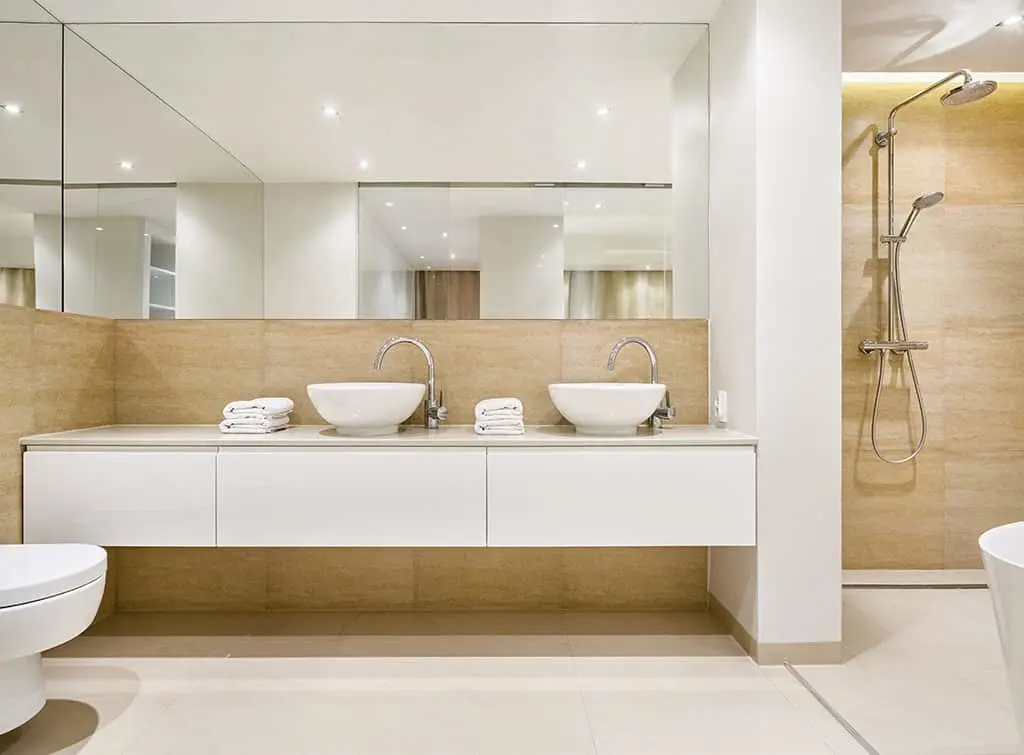
Recessed LED downlights remain one of the easiest bathroom ceiling lighting ideas to live with.
Because they sit within the ceiling, they don't visually crowd the room and work particularly well in modern bathrooms, small spaces and rooms with lower ceilings.
The trick is in the positioning.
Rather than automatically filling the ceiling with an evenly spaced grid, think about what you're actually illuminating. Downlights can be positioned to wash light over a tiled wall, brighten the shower or draw attention to a particularly lovely vanity unit.
It may seem like a small thing, but it can make your lighting look deliberately designed rather than simply installed.
2. Choose a flush ceiling light for lower ceilings
Not every bathroom has the ceiling height for a pendant.
A flush or semi-flush ceiling light gives you the opportunity to introduce a more decorative fitting without sacrificing valuable headroom.
They're particularly useful in:
Bathrooms with low or sloping ceilings
Look beyond the standard functional bathroom fitting, too. Opal glass, ribbed glass and simple metal detailing can bring plenty of character without dominating a compact room.
3. Make a statement with bathroom pendant lights
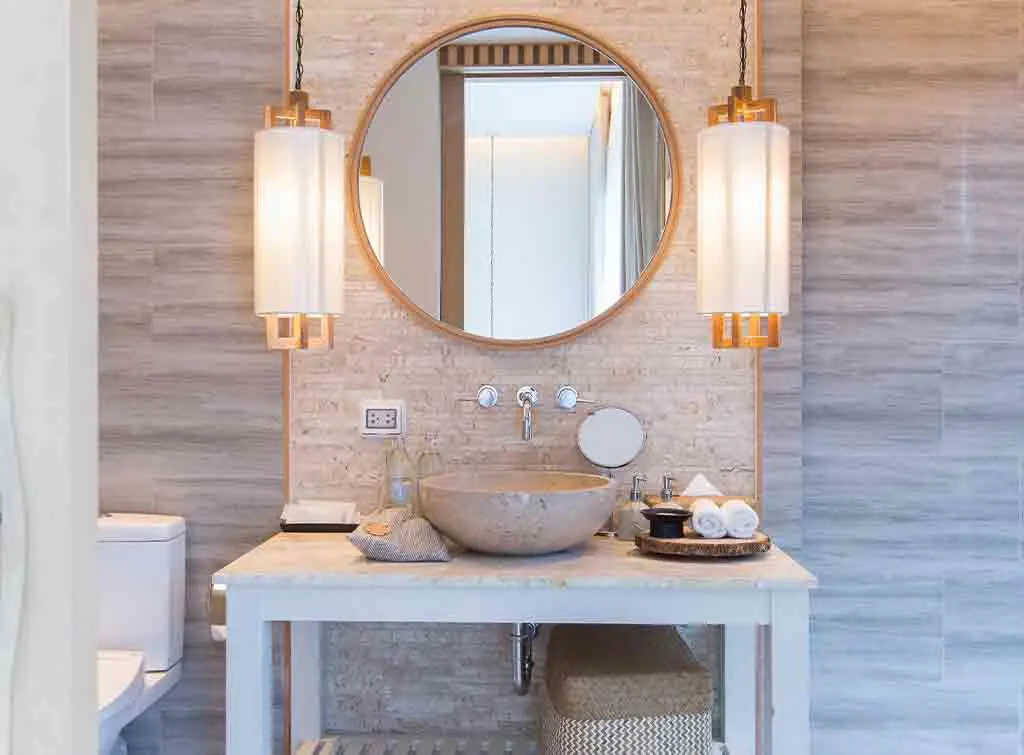
If you have the space and ceiling height, a pendant light can turn something functional into a genuine design feature.
A single oversized pendant can look striking in a larger bathroom, while smaller pendants can work beautifully beside a vanity or in a carefully chosen corner.
Scale matters here, though. A fitting that looks well proportioned in a showroom can suddenly look enormous once it's hanging in your bathroom.
And before falling in love with a particular light, check that it's suitable for where you want to put it. Bathrooms have specific electrical zones and IP rating requirements. Your electrician can guide you on this.

4. Layer your bathroom lighting
One of the biggest lessons when planning bathroom lighting is not to expect your ceiling lights to do every job.
A good layered lighting scheme combines:
General ceiling lighting for overall brightness
Task lighting around mirrors and vanities
Accent lighting to bring warmth and atmosphere
This means you can have plenty of light for shaving, make-up or cleaning without having to sit under bright ceiling lights when you want the bathroom to be somewhere you can unwind.
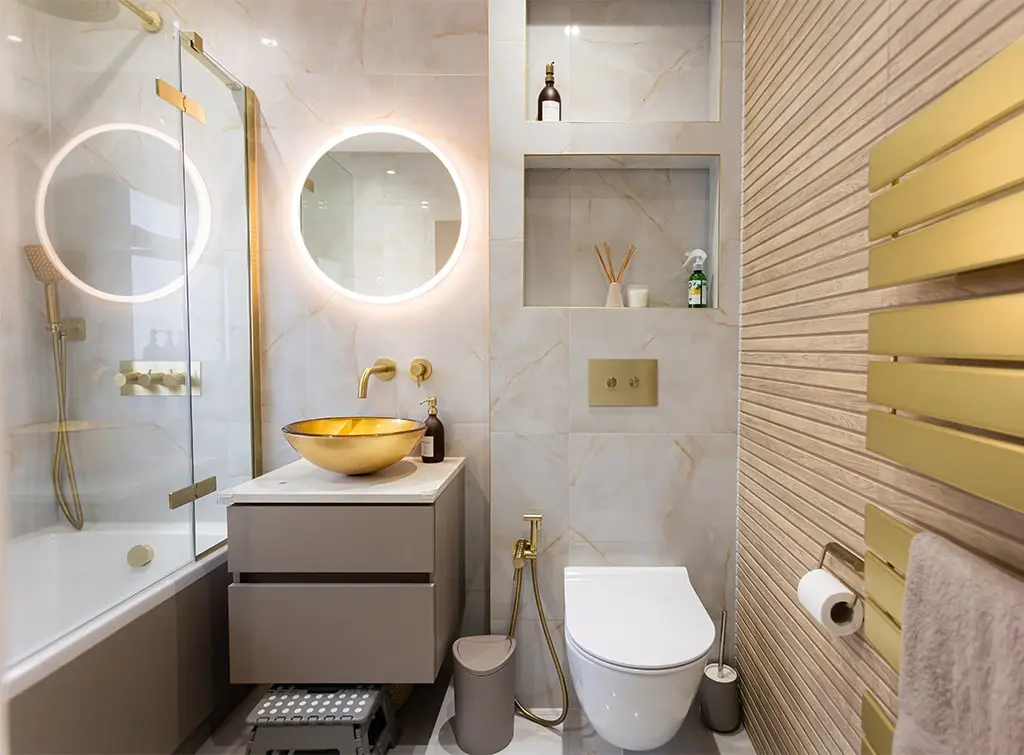
Backlit mirrors, wall lights, illuminated niches and discreet LED strips can all work alongside your main bathroom ceiling lights.
For a deeper look at how to combine the different types of bathroom lighting, read our bathroom lighting buying guide.

5. Use adjustable spotlights to highlight the good bits
Adjustable ceiling spotlights let you decide exactly where the light falls.
Rather than simply illuminating the middle of the floor, you can direct light towards textured tiles, a statement basin, artwork or another feature you've spent time and money choosing.
They're also handy in awkwardly shaped bathrooms where fixed ceiling lighting can leave darker corners.
Just be careful around mirrors. Light coming directly down onto your face can create shadows under your eyes, nose and chin, so dedicated mirror lighting usually does a better job where you shave or apply make-up.
6. Bring in softer light around the bath
Not every bathroom light needs to be bright.
If your bath is somewhere you genuinely use to relax, think about what the room looks like when the main ceiling lights are switched off.
Soft lighting from an illuminated niche, concealed LED strip or dimmable fitting can completely change the atmosphere.
It's one of those details that's easy to overlook during a renovation. You spend so much time thinking about tiles, taps and sanitaryware that lighting can become an afterthought.
But it's often the lighting you notice most once you're actually living with the finished room.

7. Try concealed ceiling lighting
For softer light without another visible fitting, consider hiding LED lighting within a recessed or dropped ceiling detail.
Rather than seeing the light fitting itself, you see the glow it produces.
This can work particularly well in contemporary bathrooms where you want clean lines, or where brighter downlights are already taking care of the practical side of things.
Used around the perimeter of a ceiling, concealed lighting can also draw the eye upwards and give the bathroom a sense of depth.

8. Match your bathroom lights to your finishes
Bathroom lights don't necessarily need to disappear into the ceiling.
Brushed brass, bronze, matt black and chrome fittings can echo the finish you've already chosen for your taps, shower controls or handles and help pull the whole scheme together.
But it's not essential for everything to match perfectly. Sometimes repeating a finish just once or twice is enough to make a room look considered without becoming overly coordinated.
This is particularly useful if your bathroom itself is quite simple and you're looking for a way to introduce a touch more character.
9. Use statement lighting in a larger bathroom
Larger bathrooms give you more freedom to treat ceiling lighting as part of the decoration.
A sculptural pendant, cluster light or chandelier can provide a focal point in a room that might otherwise have a lot of hard, flat surfaces.
The important thing is not to sacrifice practicality for the statement.
Decorative ceiling lighting works best as part of a layered scheme, with separate task lighting where you need clearer visibility and sufficient general lighting for everyday use.

10. Keep small bathroom ceiling lighting simple
In a small bathroom, ceiling lighting usually works best when it doesn't compete for space.
Recessed downlights and neat flush fittings keep sightlines clear, while a backlit mirror or carefully positioned wall light can provide another layer without cluttering the ceiling.
You don't need lots of lights either. A smaller number of well-positioned fittings can be far more effective than squeezing spotlights into every available section of ceiling.
If you're working with limited space, you may be interested in our small wet room planning guide. It has plenty more ideas for making every centimetre count.
Bathroom renovation by Checkatrade member, SM London Construction Ltd
11. Make lighting part of your spa bathroom ideas
If you're aiming for a spa-like bathroom, lighting can make just as much difference as the bath or tiles.
Warm, diffused lighting tends to be much easier to relax around than one bright overhead source. Try combining subtle ceiling lighting with illuminated niches, under-vanity LEDs or a softly lit mirror.
Being able to dim or separately control different lighting layers makes this much easier.
The aim isn't to make the bathroom dark. It's to give yourself the choice between properly awake and not quite ready for the day yet.
Don't underestimate colour temperature. Cool-white bulbs can make a beautifully finished bathroom look surprisingly clinical, especially with pale tiles and lots of reflective surfaces. If you're aiming for a softer, more relaxing atmosphere, a warmer white can make a huge difference. It's worth checking the colour temperature before you buy all your bulbs or fittings.
12. Don't forget natural light
Sometimes the best bathroom lighting idea starts with switching nothing on at all.
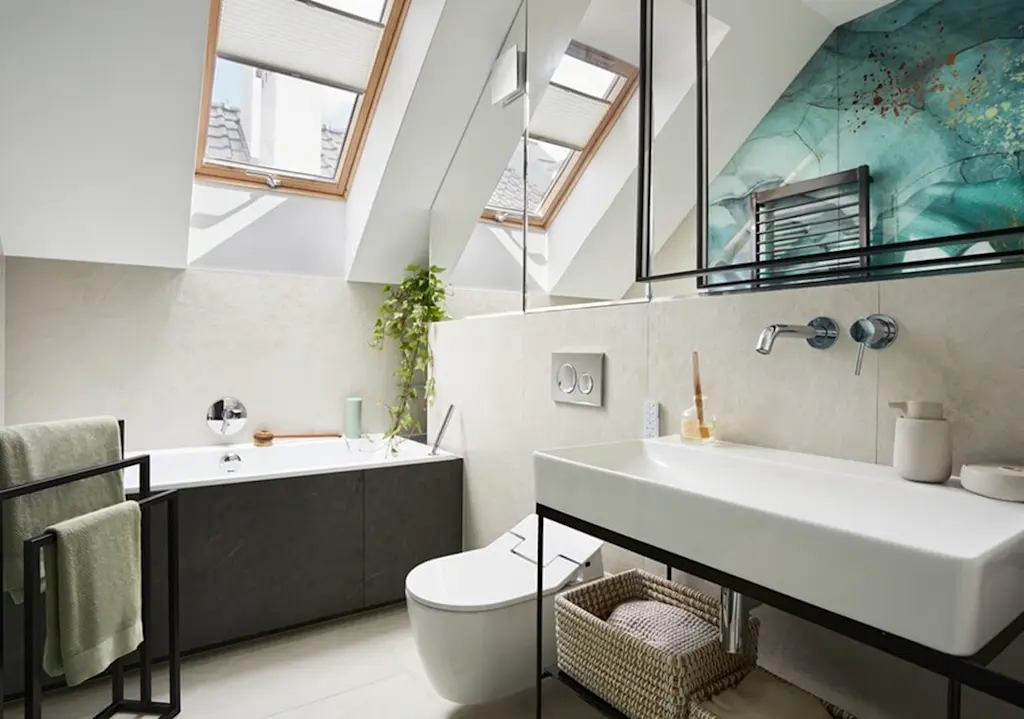
If your bathroom has a window or rooflight, pay attention to where natural light falls during the day before deciding where artificial lighting needs to go.
You may find that one area already gets plenty of daylight while other spots, such as the shower or vanity, remain quite dark.
Planning your ceiling lighting around the natural light you already have can give you a much more balanced result.
Bathroom lighting safety: a quick note before you choose
Bathroom lighting needs to be suitable for use around water and moisture; you can't just install any fitting wherever you like.
Bathrooms are divided into electrical zones, with different IP rating requirements depending on how close a fitting is to a bath or shower.
You don't need to become an expert in bathroom electrical regulations while you're gathering ideas. But it's worth checking suitability before buying an expensive fitting that can't safely be installed where you imagined it.
Our bathroom lighting buying guide explains bathroom zones, IP ratings, colour temperature and the different types of lighting in more detail.
Save the exact lights you love, but don't order them purely on looks. Show your choices and intended positions to your electrician first so they can check the IP rating and suitability for that part of the bathroom.
Common bathroom lighting mistakes
Bathroom lighting mistakes are often less about choosing an unattractive fitting and more about discovering that the room doesn't work quite as well as you'd hoped once you're using it every day.
Watch out for:
Relying on one ceiling light for the entire room
Positioning downlights so they cast shadows across your face at the mirror
Installing too many downlights and making the bathroom overly bright
Forgetting how you'll use the room at night
Choosing decorative fittings without checking their IP rating
Mixing noticeably different colour temperatures without meaning to
Leaving lighting decisions until the end of a bathroom renovation
Forgetting to make the most of natural light
Bathroom ceiling lighting ideas checklist

Before settling on your bathroom lighting ideas, think about:
When it's worth getting help
Bathroom lighting involves electricity in one of the wettest rooms in your home, so installation isn't the place to experiment with DIY.
A qualified electrician can help you work out suitable positions, confirm bathroom zones and IP ratings and install the fittings safely.
If you're still at the ideas stage, start by saving examples of the lighting schemes you like rather than individual fittings alone. That gives you something useful to show your electrician when you're ready to turn those ideas into a practical lighting plan.

Need a little help bringing your lighting ideas together?
If you like the idea of layered lighting but aren't quite sure how to make it work in your bathroom, a lighting designer can help you plan the layout, choose fittings and get the balance right between practical task lighting and softer, more atmospheric light.
And when it comes to installation, always use a qualified electrician. They can check bathroom zones, IP ratings and make sure your chosen lights are installed safely.
Find a lighting designer near you or search for a qualified electrician in your area when you're ready.
Browse checked electricians covering your local area
Enter your postcode to find a top tradesperson near you
David Brookes Electrician
10.00
(46 reviews)Services & skills
ElectricianLighting DesignHot Tub WiringFault FindingElectric CookersJoseph & Joseph Electrical Ltd
10.00
(25 reviews)Services & skills
ElectricianLighting DesignElectric HeatingElectric RadiatorsEmergency Electrician ServiceArc Electrical
10.00
(26 reviews)Services & skills
ElectricianLighting DesignElectrical Under Floor Heating RepairSmoke AlarmsLED LightingGreenhills Electrical
10.00
(136 reviews)Services & skills
ElectricianLighting DesignElectrical ContractorsElectrical Installation Condition Report - Safety Checks - EICRHot Tub WiringDS Lavender Limited
10.00
(149 reviews)Services & skills
ElectricianLighting DesignEnergy Efficient LightingEmergency Electrician ServiceStorage HeatingE F S Solutions
10.00
(77 reviews)Services & skills
ElectricianLighting DesignElectrical ContractorsElectric StovesExtractor Fans


FAQs
What is the best lighting for a bathroom ceiling?
The best bathroom ceiling lighting provides good overall illumination while working alongside task and accent lighting. Recessed downlights and flush ceiling fittings are practical choices for many bathrooms, while pendants can add a decorative focal point where ceiling height and bathroom zones allow.
What is the current trend in bathroom lighting?
Current bathroom lighting is moving towards layered schemes rather than relying on a grid of ceiling spotlights. Sculptural fittings, warm finishes, concealed LEDs, illuminated niches and lighting that can change from bright and practical to softer and more atmospheric are all influencing contemporary bathroom design.
What are common bathroom lighting mistakes?
Common mistakes include relying on one light source, using too many downlights, creating shadows around the mirror, mixing colour temperatures and choosing fittings without checking their bathroom IP rating. Planning lighting alongside the bathroom layout rather than afterwards can avoid many of these problems.
What is the general rule for lighting in a bathroom?
A good general rule is to layer bathroom lighting so you have overall illumination, dedicated task lighting and softer accent lighting. Any fittings also need to be suitable for the bathroom zone in which they're installed.
What is the most flattering bathroom lighting?
Soft, even lighting positioned around the face is generally more flattering than a strong downlight directly overhead, which can create shadows. Lighting either side of a mirror or an evenly illuminated bathroom mirror is often a better choice for shaving and make-up.
What do Zone 1 and Zone 2 mean in bathroom lighting?
Bathroom zones indicate how close an electrical fitting is to water and therefore what level of protection it needs. Zone 1 covers the area above the bath or shower up to 2.25m high, while Zone 2 extends up to 0.6m outside the bath or shower perimeter. Different minimum IP ratings apply, so check your chosen fitting with a qualified electrician.
Can you run a bathroom extractor fan off a lighting circuit?
Bathroom extractor fans can sometimes be connected to a lighting circuit so they operate with the light, but the appropriate arrangement depends on the fan, circuit and installation. A qualified electrician should determine how your fan is wired and ensure the work meets current electrical requirements.
Should a bathroom have warm or cool lighting?
It depends on how you use the space. Warm white light, typically around 2,700–3,000K, creates a softer atmosphere, while cooler light can be useful for detailed tasks around a mirror; many bathrooms benefit from combining practical task lighting with warmer ambient light.
Is recessed lighting OK in a bathroom?
Yes, recessed lighting can work very well in bathrooms, particularly where you want a clean ceiling or have limited headroom. The fitting still needs an appropriate IP rating for the bathroom zone where it's installed, so check suitability before buying.


See the tradespeople we've checked for your job